
Commercial Real Estate • Business Brokers • Acquisition Entrepreneurs
The World's First Done-For-You Direct-to-Seller Deal Pipeline System
Every month, deals you should be closing go to someone else.
Pipeline Machine is built to systematically target, contact, nurture, and handoff pre-qualified, off-market deal opportunities... from first-contact to never-ending follow-up.

"In one of our more difficult campaigns, we were targeting fuel wholesalers (direct-to-seller) for an experienced acquirer. These wholesalers, aka "jobbers," are barely online & have minimal public footprints. They're often second- or third-generation owners, and live in an old school brick & mortar world... so we literally had to Deep Dive Skip Trace key Decision Makers through their spouses, parents, and siblings (because the actual owner's contact info didn't exist in any database). That's the type of problem solving built into Pipeline Machine.
- Marshall Hatfield, REVAS Founder & Advisor
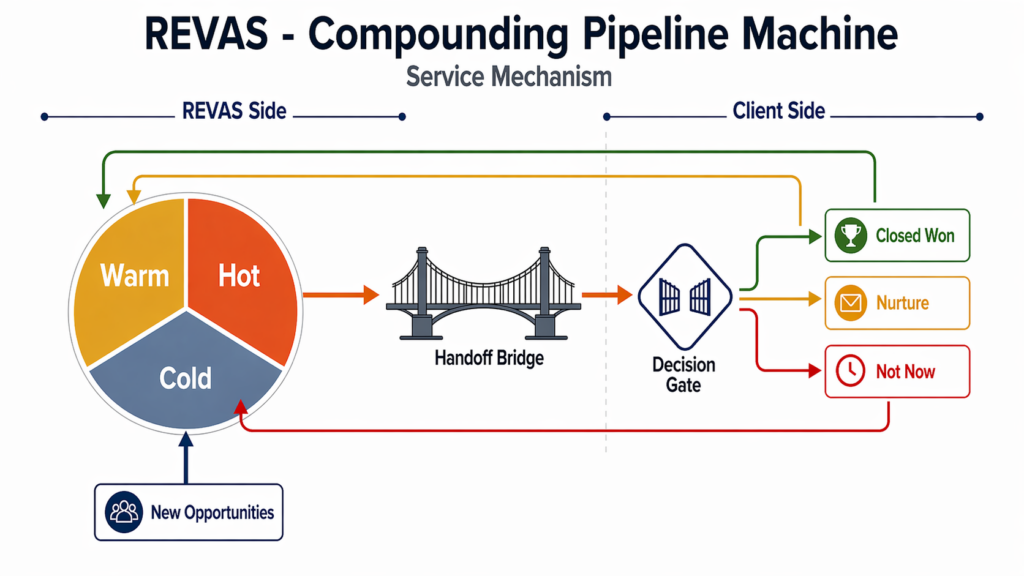
Every new contact enters the loop Cold. From there, we cultivate the relationship – calls, emails, DMs, check-ins – until it warms. Once a contact is pre-qualified and Hot, we hand them across the Bridge to your team.
Here’s the part that makes the loop a loop. After the handoff, every contact comes back:
• Closed Won → returns to Warm for the next deal
• Not Ready → returns to Warm for continued cultivation
• Lost → returns to Cold, dormant until the timing changes
Nothing leaves the system. Your pipeline continuously grows over time.
Three coordinated Jobs, three Pillars in each. All nine Pillars run at the same time – every one doing distinct operational work, none of them in isolation.
Job 1: Targeting – Builds the universe of who you should be talking to.
Job 2: Outreach – Makes contact across every channel that works.
Job 3: Nurturing – Turns those conversations into pre-qualified handoffs.
Each Pillar feeds the next. Together they run as one coordinated pipeline operation.
⚠️ IMPORTANT: Pipeline Machine doesn’t compress sales cycles. If you need a closing in <90 days, stop here. This would be a bad fit, and we’d rather tell you now than waste your time or disappoint you later.
If you decide Pipeline Machine is worth exploring for your operation, here’s the path to launch.
1. Download the Briefing. (Optional) Fifteen pages on the Closed Loop Mechanism, the 9 Pipeline Pillars, the economics, and the case work. It’s the easiest way to evaluate Pipeline Machine on your own terms — and to share with whoever else needs to weigh in on your side before the conversation.
2. Book a Strategy Session. Thirty minutes with REVAS CEO Ali Murtaza. He’ll diagnose your current sourcing situation, forecast pipeline velocity at your target tier, and help you calculate break-even and ROI to decide whether Pipeline Machine is the right fit for your operation.
3. Hire Us to Build Your Pipeline. Substantive seller conversations begin inside 45 days. First warm handoffs typically land between day 60 and day 90. First closings come 9 to 18 months out, sometimes much sooner depending on your sales cycle. You’ll see the pipeline filling in real time, with weekly updates by the end of your first month.
These are the five failure modes we’ve watched our clients run, in every combination and order imaginable. Each one fails in its own specific way, and each failure is structural rather than situational.
The CEO, GP, or principal broker is also the one personally chasing every deal.
Maybe a personal assistant helps at the back end. Maybe a junior acquisition associate picks up the relay from Due Diligence to Closing. But the relationship-building and the systematic follow-up live with the founder.
The result:
Letting the deal flow come to you instead of going to it.
The brokers you know send the occasional intro. The referral network produces a deal every few months when the timing happens to line up. On-market listings hit your inbox and you take a shot when something looks decent.
This is the weakest position in the entire acquisition chain. Brokers and on-market deals mean somebody else already shopped the deal first, which means:
We’ve watched even well-capitalized acquirers in our client base sit on dry powder for quarters at a time, because their entire sourcing strategy was “wait for the right thing to come through.”
Hiring an outbound marketing agency or consultant to run Cold Email or managed ad campaigns on your behalf.
Looks affordable on the surface:
But the outbound services space is still genuinely the wild west, even in 2026. Common outcomes:
The wild-west part of this industry isn’t getting tamer over time. It’s just getting noisier.
Hiring a US-based telemarketer or telemarketing agency to run cold outreach for you.
Overseas cold calling rarely works in our ICPs, so the US-based premium gets paid:
And the list problem never goes away:
The result is a campaign that costs more than it should and produces inconsistent enough output to make every quarter a coin flip.
Building an outbound team internally, and absorbing the cost and management overhead in-house.
The role might be called:
This is the option operators have most often seen actually produce results, at least partially, when the right person lands in the seat.
But the cost is real:
The deeper structural problem is the one most operators don’t see until they’re already a year in:
At best, any single BizDev hire might really know only two or three of the nine operational disciplines that make outbound pipeline work.
They might be strong on the cold calling and the live qualification. But the list-building, the multi-channel orchestration, the CRM hygiene, the long-term nurture, and the systematic reactivation are still missing entirely.
So you’ve taken on all the cost and management overhead of an in-house team without actually closing the structural gap.
They wanted a pipeline that gets bigger every month instead of one where last month’s work disappears. They wanted relationships that grow over time instead of leads that expire in a quarter. And they wanted a team that closes deals instead of one that spends half its bandwidth chasing them.
There’s a reason none of these failure modes ever stuck as the actual solution for our clients, and we’d watched every one of them fail in different versions for more than a decade. So we finally decided to build the solution to the actual underlying problem, once and for all.
We’ve been on the vendor side of the very services you’ve hired and fired over the years:
From that seat, we watched the same patterns of failure play out across every vertical, every deal size, and every campaign structure imaginable.
Our founder, Marshall Hatfield, has spent most of his career running deal-sourcing engines as an operator himself, first as a commercial real estate agent and investor, and more recently as a business broker and M&A advisor.
The view from both sides of the desk is what eventually told us that the patterns we kept seeing weren’t accidents at all:
For most of those thirteen years, we ran lead generation campaigns the same way everyone else in the industry did. Some of them worked and some of them didn’t, and it wasn’t obvious as to what made the real difference.
The pattern took us years to see because it wasn’t about which campaigns had better lists, or sharper scripts, or harder-working ISAs. The successful campaigns shared two structural characteristics:
The reservoir kept growing on those campaigns, while every other campaign was effectively starting over from scratch every single month.
Of course, to see this play out takes months and years. And then building a systematic solution takes seeing it play out over and over again to properly understand how to fix it. Put simply:
The winning campaign isn’t about a better list, or making more contact attempts.
It’s about being (and staying) in front of the right Decision Makers, at the right time, no matter how long it takes.
That realization was the moment we stopped focusing on “lead generation” as such, and built something different that’s actually designed to solve for the underlying problem.
We built Pipeline Machine as the cure to a diagnosis no other solution in the industry is trying to solve.
Here’s a story from inside one of our campaigns. The names are withheld, but the story is true.
We’d been talking to a potential seller on behalf of a Pipeline Machine client, and the seller suddenly went quiet for a couple months. No big deal: this is a normal pattern.
Three months later, the seller’s circumstances changed and he was suddenly ready to move. So he started reaching out:
By the time we finally reconnected, it was unfortunately bad news:
The seller had already listed with a Business Broker.
Now we were competing against everyone on the open market, and stuck dealing with one of those Brokers you have to chase for a week just to get them to send the NDA.
The advantage of going direct-to-seller disappeared in a matter of weeks, after just a few missed communications.
But this isn’t a story about one specific example:
This is about a category of failure that every sourcing operation experiences.
Put simply:
You’ve been focusing on a lead generation problem. What you actually have is a pipeline problem.
No human-centric system can keep up with every signal in a deal pipeline all the time. Opportunities will slip through the cracks.
It’s far too easy to miss critical re-engagement signals like:
These are the types of problems that Pipeline Machine’s Closed Loop Mechanism is specifically designed to address. The Post-Handoff Pulse and the systematic re-engagement timeline catch the signals that no human-bandwidth follow-up can reliably catch.
That’s pipeline operations.
And it’s exactly what Pipeline Machine is built to run.
With Pipeline Machine, the seller who went quiet doesn’t disappear into a spreadsheet. He sits in the Warm zone with a scheduled check-in and automated follow-up touches.
And when he re-engages on any channel, the operator gets alerted in real time, and catches it before anyone else.

"A person is not a solution to a problem without a process. That's why everything we do is always Process-Based, Not People-Based."
- Marshall Hatfield, REVAS Founder & Advisor
Even when a person can solve a problem, it’s only because they already know the correct process to implement. The process is what does the work, and the person is the conduit.
Let me show you both. First the Closed Loop, which is the architecture that compounds relationship value over time instead of resetting to zero every billing cycle. Then the 9 Pipeline Pillars, which are the daily practice the operator and back-office team run inside it.
Want a Full Pipeline Machine Breakdown?
Download the Pipeline Machine Briefing:
A 15-page walkthrough of the Closed Loop Mechanism, the 9 Pipeline Pillars, the economics, the ROI math, and everything you need to know before moving forward.
This is the easiest way to see precisely what’s included in Pipeline Machine, so you can quickly share & discuss with your team.
Pipeline Machine is a Done-For-You Deal Pipeline Operation. We run the entire pipeline on your behalf.
Whether you’re looking for your own acquisitions, or you’re a broker looking for sell-side engagements, our goal is simple:
Your team is freed to focus on diligence and closing.
We take care of all the grunt work to go from raw data to pre-qualified seller meetings on your calendar.
From list building & data enrichment, to cold calls & cold emails, to the never-ending follow-up: we handle everything that doesn’t require your direct input, so you can give all your attention to work that suits your pay grade.
A US-based Pipeline Operator runs point on the live relationship work: the calls, the conversations, the cultivation, the pre-qualification – this is a legit acquisition specialist with experience running these exact types of campaigns.
Behind the Operator, a systematic back-office team handles everything else: the data work, CRM customization, email server management, and the dozen other things that have to run smoothly for the front-end conversations to happen.
All of this is overseen by our Operations Manager and the CEO personally, delivering a white glove experience where all you really have to do is go to meetings with pre-qualified sellers.
You won’t find this structure anywhere else in the “lead gen” space. Most vendors deliver leads. We deliver a managed pipeline that gets bigger every month it runs.
Most lead gen services focus on generating “leads.” It’s not always clear what this even means, and then you’re expected to figure out how to transform these “leads” (potentially of dubious quality) into a profitable pipeline from there, on your own. Most lead generation services are doing handoffs blind:
Leads arrive flat, with no idea how they got to you, or where you’re entering the conversation.
That’s why we built Pipeline Machine to be different:
It’s a continuous, closed loop.
Nobody leaves the loop unless they explicitly request it. No opportunities slip through the cracks.
Contacts move through three temperature zones:
All of that is pretty standard. Here’s what actually makes this approach different.
After every handoff, the contact eventually circles right back into the Closed Loop:
What you end up with is a compounding pipeline asset that gets bigger every month, converting more deals the longer it runs.
Month four is larger than month three. Month nine is larger than month six. That’s the whole point of building a pipeline asset instead of chasing leads.
STORY TIME! In 2023, I missed out on a crazy sell-side opportunity when I received a warm introduction to a top regional property management owner looking to sell. This was a multimillion-dollar deal with operations in several of the country's hottest metros.
When I met him, he said he was barely testing the waters. I called him up a few weeks later to check in, and he told me: "It's already been sold."
I couldn't believe it. But when I got the full story, it turned out he'd basically accepted a blank check from another local owner he'd known for 20+ years through their industry trade association.
That situation changed my whole perspective on relationship building & follow-up. The only way to win long-term is to be in the room with sellers long-term as well - WAY before they actually think they're ready to sell. By then, it might already be too late!
- Marshall Hatfield, REVAS Founder & Advisor
Want to See How It Would Work for Your Business?
Book a Strategy Session Call:
This 30-minute conversation with REVAS CEO, Ali Murtaza, will help clarify every open question you might have about Pipeline Machine.
Plus, we’ll run custom break-even and ROI projections using your real-world numbers, so you’ll see in plain dollar amounts whether the service is a good fit for your scenario.
We can even run best-case and worst-case scenarios, so you’ll know exactly what the campaign needs to produce to be a winner for your operation.
This is the easiest way to find out if Pipeline Machine makes sense in your specific situation.
While we introduced the 9 Pipeline Pillars above, we only briefly covered the details of how they function. Here’s the in-depth walkthrough of the heart of Pipeline Machine: three jobs, three pillars each, all running simultaneously to power the Closed Loop.
Before any outreach happens, the universe gets built and graded against your deal qualification criteria.
You get a real target list built from scratch against your custom tailored deal criteria.
You reach the owners standard data sources can’t find: the hard-to-track decision-makers your competitors miss entirely.
First contact runs across every channel that works in your vertical, coordinated rather than scattered.
You get a US-based acquisition specialist on the phone with your targets, qualifying conversations in real time.
Your email outreach lands in inboxes, not spam folders, with replies routed straight to a live operator.
You reach senior decision-makers through the digital channels most competitors don’t even run.
Channel mix gets optimized continuously based on what’s working in your vertical.
Once a contact engages, the cultivation work begins.
Only pre-qualified contacts reach your calendar: every target is verified, documented, and confirmed as a decision-maker before any handoff.
You step into every meeting with the full relationship context already on the table, ready to close.
The 9 Pipeline Pillars run as a coordinated system. Your deal flow is never reliant on a single tactic. With an integrated 9-Pillar system, you stop chasing leads and start building a pipeline asset.

"This is what your in-house team would be doing... if they had the time, the tools, and the bandwidth."
The campaigns below are real. Each one highlights a different Job within the Pipeline Machine System: building the universe, reaching the owner, and qualifying the asset.
Of all the campaigns we have run, fuel wholesalers (in the oil & gas industry) were the most difficult Target Universe to build, ever.
These are the operators who supply the gas stations, known in the trade as jobbers. Most are second or third generation family businesses, run on handshakes and pen & paper.
There was no list to scrape from the internet. There was no data broker with this segment pre-built. These owners are not on social media. They’re hard to find on Google.
So we hunted them the way a Private Investigator would:
Then we used those people to triangulate on the key Decision Maker(s). If we couldn’t reach the DM on their direct line, we approached their close connections to earn a warm introduction. We were even hand-writing personal letters and mailing them with live stamps, just to further demonstrate our seriousness.

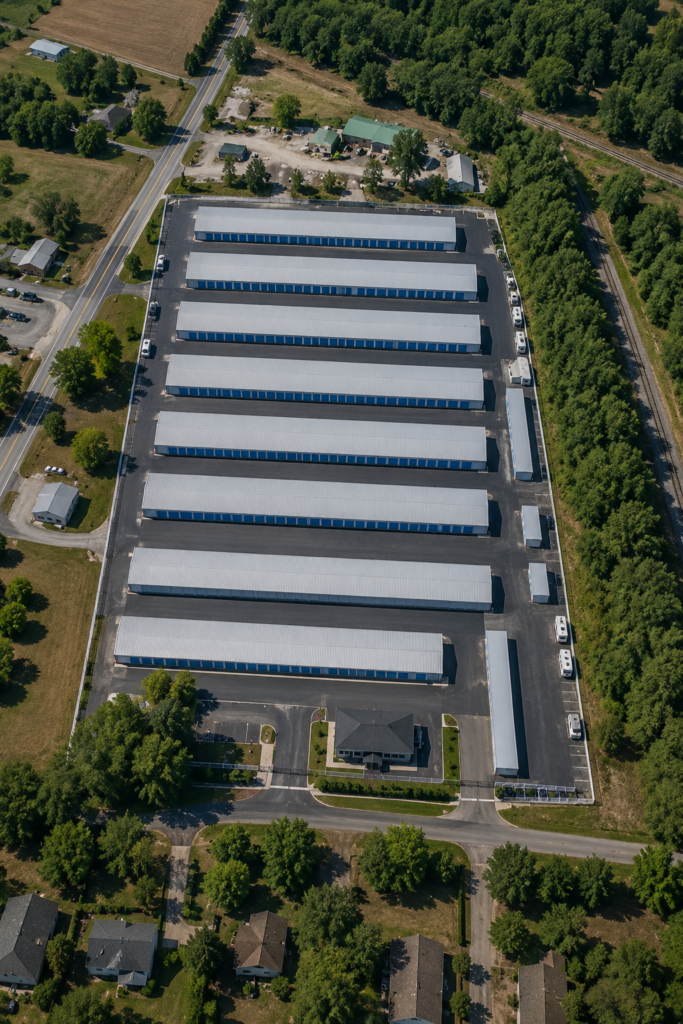
A self-storage acquirer working the Mid-Atlantic market engaged us to systematically source distressed and underperforming facilities directly from owners.
The Target Universe was large, but full of false positives. First, all the big public companies needed to be eliminated (Public Storage or CubeSmart are not our target sellers). Then, we had to find the sweet spot of Mom & Pop Owners who weren’t so big to be unrealistic on their pricing, but not so small the deal stopped making sense.
To accomplish that filtering, just the raw real estate data wasn’t enough:
We actually had to build a system to review satellite imagery for our targeting process!
So the filtering happened upstream. The back-office team pulled Google Earth imagery for every facility on the target list and worked through each one systematically:
That third signal was one of the most powerful targeting metrics. By identifying parcels with room to build, the acquirer knew which facilities had the most upside potential before a single cold call.
Facilities that passed this filtering mechanism were the only ones to enter the outreach queue. The ones that didn’t were noted but deprioritized, ready to be revisited if the client’s criteria shifted later in the campaign.
Laundromats break the usual data model. The business owner rarely owns the real estate, so property records are dead-ends. And laundromats are frequently in generically named holding companies, so connecting the storefront to the LLC is also tricky.
This means entity searches, cross-referenced filings, and manual research are the only options.
The bigger problem was actually getting in touch with them.
The laundromat industry is a diverse bunch, but once you start to understand their online habits, you can really break through. The secret, we found, was Facebook Groups! Some pretty large owners are extremely active on there, and many others are always lurking. So we got involved:
That did two things. It surfaced hot opportunities directly – owners posting about exits or testing the waters in-group. And it built credibility, so eventual direct outreach didn’t land cold.


A multifamily investment manager hired us to source direct-to-seller acquisition opportunities.
Cold calling was the obvious channel. LinkedIn worked too, for a certain market segment. But the top-performing channel surprised everyone:
The campaign also stood up a custom deal-tracking environment with Street View overlays and embedded P&Ls and rent rolls. For the High Value Targets, we commissioned field-research videos: local gig workers walking the property, recording everything, and talking to residents and on-site staff.
By the first call with an owner, we knew more about the property than they did.
Property Management M&A was one of the first market verticals in which we were successful. A long-term client with a large regional operation has been with us through multiple closings over multiple years.
That allowed us to practically saturate their Target Universe, building long-term relationships with dozens of owners in various stages of exit planning (and hundreds more who haven’t even considered it yet).
Either way, everybody exits eventually, so our job is to be in the room before that happens.
The Pipeline Operator has gotten to know many of these owners personally, across the long timelines:
After more than 2 years, we’ve seen owners go from barely considering an exit to actively negotiating terms.


A boutique brokerage in downstream oil and gas hired us to source acquisitions across multi-location owners: gas station chains with at least four, and up to thirty stores.
The surprise wasn’t who the targets were; it was where these multimillionaire owners were when we called.
They were physically at their stores: walking the lot, doing inventory, and running inspection checklists. This made them reachable in ways the rest of the market wasn’t trying:
Most acquirers chase these owners through corporate filings and executive assistants, which is still important. But the direct line had been there all along.
Ready to See What This Looks Like for Your Target Universe?
Book a Strategy Session with REVAS CEO Ali Murtaza.
In 30 minutes, Ali will diagnose your current sourcing operation: what’s working, what’s leaking, and what’s missing. He’ll translate the approaches above directly to your vertical, and run live calculations of break-even & ROI math using your real deal numbers.
Each Pipeline Machine campaign is built from scratch, tailored to your specific deal criteria. The Strategy Session is the first step toward launch.
We’d rather tell you now than take the fee and have it fail in six months. Pipeline Machine doesn’t work for everyone. Here are the five scenarios where we know it won’t.
If you’re an acquirer targeting average transaction value under $500K, or a broker with average commission below $50K, the ROI math doesn’t work reliably. Pipeline Machine is built for long-cycle, direct-to-seller relationships. Low-margin, high-volume plays need a different channel.
Once we launch, first outreach begins within 2–3 weeks. Best case, first warm handoffs land between 60 and 90 days. First closings typically come 9 to 18 months out, depending on your sales cycle. Reactivation and multi-channel can accelerate the early months, but nothing compresses the full cycle. If you need to close inside 90 days, you don’t need outbound. What you need is a closer pushing what’s already in your pipeline across the finish line.
The whole point of Pipeline Machine is delivering warm, pre-qualified introductions to Decision Makers in your Target Universe. Past the Handoff Bridge, you take over. We can’t get into deal terms or negotiations beyond surface Q&A. Someone on your team has to be ready for those handoffs and capable of pushing solid deals to the closing table. No closings, nobody gets paid.
Pipeline Machine compounds because the Closed Loop has enough surface area to keep generating new conversations and re-engaging dormant ones. Below ~1,500 viable contacts, we saturate the universe before the loop has time to compound. Smaller Target Universes can occasionally still produce, but 1,500 is the typical hard floor for a campaign to work the way it’s built to.
With rare exceptions, we don’t work with acquirers or brokers on their first transactions. Pipeline Machine produces warm conversations. Converting those conversations into closed deals requires systems, scripts, and a closing process your team already runs in their sleep. The more your category is just part of your day-to-day, the higher the probability we both win. First-time searchers hunting an inaugural acquisition are almost always a bad fit, no matter how well-capitalized.
Still reading after all that? Good.
Now let's talk about the real numbers: what you get, what it costs, and how to calculate your ROI.
This is the complete recipe for the Pipeline Machine system, broken down component by component. For each item below:
Read it as a build-spec: this is what you’d be on the hook for if you tried to assemble the same operation in-house.
This is your dedicated Acquisition Manager, Corporate Development Associate, and Deal Sourcing Specialist, all rolled into one. They’re the point person for every new and existing relationship in your Target Universe. Day to day, they run live calls, hold real conversations, qualify in real time, and cultivate relationships across months and quarters.
Every Pipeline Operator we place has 2–4+ years of real estate or B2B sales experience. They speak the language of complex deal-making, handle objections from sophisticated owners, and pivot in real time as a conversation develops.
Cold calling isn’t a skill you can teach in a six-week training program. It either lives in someone’s posture and instinct, or it doesn’t. We hire for the instinct, and we screen out everyone else.
In-House Equivalent: $100,000+ per year (plus bonuses) for a comparable full-time senior US-based salesperson in any major metro.
This is your dedicated Data Specialist, CRM Administrator, and Digital Outreach Specialist, all working as one coordinated back-office team. They handle every part of the operation that isn’t a live conversation: sourcing data, enriching lists, building and maintaining the CRM, running the bulk digital outreach, and producing your reporting.
The Pipeline Operator focuses on live conversations. The back-office team focuses on everything that makes those conversations possible.
It’s a coordinated team rather than a single generalist for a structural reason: no one person has world-class skill across data ops, CRM ops, deliverability, and digital outreach. Treating it as one role guarantees mediocrity across all four.
In-House Equivalent: $35,000–$50,000/year in partial-FTE coverage across the required roles.
Our Operations Manager runs point on every active Pipeline Machine campaign, with CEO Ali Murtaza personally involved in every engagement.
They run weekly QA on campaign output, lead monthly pipeline review calls with you, make strategic adjustments when channel performance shifts, and step in directly when high-value handoffs need extra coordination.
This is the layer most done-for-you services skip entirely, and it’s why most done-for-you services produce inconsistent results. Without operational oversight, the front-line team drifts. With it, the campaign stays calibrated month after month.
In-House Equivalent: ~10% of a senior ops leader’s time, plus founder-level strategic input. Ballpark $20,000+/year in dedicated fractional ops-leadership.
We build your Target Universe from scratch, against your specific deal criteria. The data comes from a stack of paid B2B and B2C databases, public records, county filings, MLS feeds, Google Maps and satellite imagery, social platforms, and custom scrapers we build ourselves when no existing data source covers your segment.
The universe is the foundation everything else runs on. A weak universe produces weak conversations regardless of how well the rest of the pipeline runs. We build it manually, vertical by vertical, because no off-the-shelf list does this work for the deal sizes and direct-to-seller targeting Pipeline Machine is designed for.
In-House Equivalent: $5,000 setup + $15,000/year in data subscriptions and ongoing list-build labor.
We’ve built a custom internal process that appends the contact data needed to actually reach every target in your universe. That means direct phone numbers, email addresses, social profiles, and identification of the decision-maker inside every target organization.
The process combines multiple tools and includes AI for the more complicated cases, so the enrichment scales without sacrificing accuracy.
Without this layer, the Pipeline Operator wastes 30% of their time chasing wrong numbers and outdated contacts. With it, every call attempt is targeted, every email is deliverable, every DM lands at a real decision-maker.
In-House Equivalent: $25,000 build-out + $6,000/year in subscriptions and tool licensing.
When standard data sources come up short on your highest-value targets, we deploy investigative-grade research. We borrow tradecraft from professional skip-tracing: pulling personal contact data, mapping family and work networks, researching multi-generational ownership structures, and building asset-layer intelligence target by target.
Standard data sources fail on a meaningful percentage of every Target Universe. Owners who don’t show up in B2B databases. Second-generation operators who aren’t online. Family-owned businesses behind opaque LLC structures. The Discovery Deep Dive is how we reach them anyway.
In-House Equivalent: $15,000+/year for a trained Overseas Research Specialist. The setup cost is structurally impossible to quote: this capability comes from a decade of running these campaigns, layered into a tailored process per Target Universe.
We write the phone scripts, email sequences, social DM templates, contact-form messaging, and cross-channel follow-up cadence your campaign runs on. Every piece is built specifically for your operation, your deal criteria, and the language your sellers actually use.
Generic outreach doesn’t work in direct-to-seller deal sourcing. Sellers can spot a templated cold email or a scripted call within ten seconds. The scripts we build sound like a real operator talking to another real operator, because that’s who the Pipeline Operator actually is.
In-House Equivalent: $5,000–$7,500. Mostly a one-time cost.
We build you a fully custom pipeline engine. It includes contact scoring, automated nurture sequences, configured pipeline stages, custom views for the operator and your team, a real-time dashboard, and the weekly reporting infrastructure your team gets in their inbox.
It also runs your campaign-specific dedicated phone line and a full email deliverability stack (domain warming, DKIM/DMARC/SPF, sender IP management).
The pipeline engine is the part that runs whether anyone’s watching or not. It’s how relationships move through the Closed Loop without slipping through the cracks. Without it, the operator’s time gets eaten by manual tracking and the campaign stalls regardless of how strong the front-line work is.
In-House Equivalent: $10,000 setup + $6,000/year in subscription and tooling.
⚠️ NOTE: Some of the line items below represent dedicated time from personnel already accounted for under the People section above. Where that’s the case, the “In-House Equivalent” makes it explicit for full transparency.
Every week, you get a pipeline growth update in your inbox. Every month, we hold a pipeline review call together covering pipeline depth, channel performance, vertical trends, and any strategic adjustments worth making.
You shouldn’t have to manage the campaign yourself to know how it’s performing. Reporting visibility is baked in: the Pipeline Operator and Operations Manager bring the analysis to you, not the other way around.
In-House Equivalent: ~10% of a manager’s annual cost in dedicated reporting and review time. Ballpark $10,000+/year.
When a warm handoff stalls on your side for 30 to 60 days, we re-engage it systematically. If your team gets busy and a relationship goes cold, the Pipeline Operator catches the signal and re-engages before another broker does.
This is the single most overlooked failure mode in outbound deal sourcing, and the one we built the Closed Loop Mechanism specifically to fix. The Pulse is the operational expression of that fix.
In-House Equivalent: ~10% of the Pipeline Operator’s annual cost in dedicated stalled-handoff follow-up time. Ballpark $10,000+/year.
REVAS absorbs every recruitment cycle, training cycle, and turnover replacement on our side for the duration of your engagement. If a Pipeline Operator leaves, we replace them. If a back-office team member transitions out, we handle the handoff. Your operation never breaks because someone on our side moved on.
The talent market for senior salespeople is volatile. Building this absorption into the engagement removes the single biggest operational risk a done-for-you service carries.
In-House Equivalent: $15,000+/year in recruiting fees, training infrastructure, and transition costs. Partially overlapping with management time; partially separate.
For institutional campaigns where standard pre-qualification isn’t enough, we build bespoke deal-tracking environments. They include document collection (P&Ls, T-12s, rent rolls), asset-layer intelligence, and field-research integration. The Pipeline Operator handles the preliminary due diligence, so your team only sees opportunities that have already cleared a first-pass underwriting filter.
Some deal types need this; most don’t. When campaign economics justify it, it’s built into the engagement at no additional charge.
In-House Equivalent: Two structural paths to build the same capability.
Path A: Hire a Pipeline Operator with both underwriting AND sales capability. That seat is $120,000+ in any major metro.
Path B: Keep the standard Pipeline Operator and add a fractional analyst at $500–$1,500 per deal. At 12–20+ deals per year, that’s $12,000–$30,000/year.
If you have an existing CRM, we clean, enrich, and reactivate it during onboarding. For 25–50% of clients, this produces the first viable seller conversations in week three.
In-House Equivalent: $2,500–$5,000 in a standalone engagement.
Every twelve months, we re-score your entire pipeline reservoir from scratch. Cold contacts who said “not now” six or twelve months ago get re-engaged in a concentrated 30-day push. Recurs every year of the engagement.
In-House Equivalent: $5,000–$10,000 in a standalone engagement. Recurs annually.
✅ $260,000+ per year in hard costs (personnel, technology, and management)
✅ $40,000+ in one-time setup costs (before you can even launch)
✅ 2-3 years of learning curve (distracting you from closing deals)
So what does the done-for-you version cost?
Keep reading for the pricing structure breakdown.
This fixed monthly cost covers your Pipeline Machine operation, including the Target Universe, the People, the Technology, and all 9 Pipeline Pillars running daily.
$1,500 - $4,500 per month hard cost.These performance-based payments only occur when a Pipeline Machine deal closes for you. This keeps our incentives aligned, and is where REVAS makes our money.
Payment due at closing. Fee structures vary.NOTE: Outreach minimums (e.g. “Minimum 200+ Cold Emails”) are floors, not ceilings: when a channel is outperforming on your campaign, the Success Fee gives us every incentive to scale it well past the minimum.
For large-scale institutional acquirers and national brokerages, we offer aggressive Pipeline Machine campaigns custom tailored to your required scale.
Starting at $30,000 per month.
• Nationwide vertical exclusivity. Your Target Universe is yours alone: we won’t run a competing campaign anywhere you’re targeting.
• Multi-pod operation. REVAS deploys two or more dedicated full-time Pipeline Operators, scaled to your velocity targets.
• Priority queue for the back-office team. Your campaign always moves first when resource allocation decisions are made.
• Quarterly strategy reviews with Marshall Hatfield directly. Founder-level M&A expert input on targeting refinement, channel optimization, and emerging opportunities in your vertical.
• Custom Success Fee structure. Every Enterprise campaign includes its own unique Success Fee model, tailored to your economics and deal types.
Pipeline Enterprise is the right fit for a very small number of clients. It requires a nationwide Target Universe at minimum, preferably with 50,000+ targeted Contacts.
If you’re considering it, the conversation starts on your Strategy Session with REVAS CEO Ali Murtaza – not a pricing page.
Click here to book your call directly, and we’ll discuss your situation & goals to see whether Pipeline Enterprise is a fit.
For every deal sourced by REVAS and closed by your team, you pay a Success Fee.
The Success Fee is what keeps us economically aligned with your goals. Some acquisition-related solutions opt for sky-high retainers ($10k+ per month) or excessive Pay Per Lead fees. We don’t. We built Pipeline Machine to keep the retainer comparatively low and tie our real economics to your closings, not your monthly invoice.
The Success Fee only triggers when a deal actually closes. If a REVAS-sourced relationship doesn’t result in a closed deal, you pay zero Success Fee.
The structure of your Success Fee depends on your role in the transaction.
If you’re the direct Acquirer, your Success Fee will be tied to the purchase price of any REVAS-sourced asset you acquire.
If you’re a Broker of any type, your Success Fee is calculated as a share of the commission you earn at closing, sometimes paid as a real estate referral.*
*Our leadership team holds active real estate licenses, ready to legally & compliantly receive referrals on commissions in all 50 states, plus 28 additional countries.
We’ll break down both structures with example calculations below.
The Sourcing Fee applies when you’re the acquirer of the asset: a commercial real estate investment, a company you’re purchasing, or any other type of private direct-to-seller asset acquisition.
The Sourcing Fee you pay to REVAS is calculated based on your purchase price, using tiered percentages that step down as the deal gets larger.
(Applied to your total acquisition purchase price, on a per-transaction basis.)
| Purchase Price Range | Success Fee |
|---|---|
| First $1,000,000 | 4.5% (min $20,000) |
| $1,000,000 - $2,000,000 | 2.5% |
| $2,000,000 - $5,000,000 | 1.5% |
| Above $5,000,000 | 1.0% |
DETAILED CALCULATION WALKTHROUGH:
Let’s walk through a real-world example to illustrate.
On a $5M business acquisition:
This yields a $115,000 Sourcing Fee total, or 2.3% all-in on a $5,000,000 acquisition.
The same deal run through a business broker would carry a 6-10% fee (charged on the sell-side, but the money still comes out of your purchase price).
Compare that to the REVAS Sourcing Fee of 2.3% – which always buys exclusive, off-market, direct-to-seller access the brokered route can’t give you at any price.
ADDITIONAL EXAMPLE CALCULATIONS:
The same structure, run at other deal sizes:
The bigger the deal, the lower your effective rate. This keeps our goals aligned while staying competitive on price against every alternative: chasing traditional brokered deals, hiring a marketing agency, or scaling your own in-house direct-to-seller sourcing system.
The Referral Fee applies when you’re the one earning a commission or fee on the deal: a commercial real estate broker, a business broker, an M&A advisor, or any other transaction intermediary.
The Referral Fee you pay to REVAS is calculated as a percentage of what you earn at closing – and the more you make on the deal, the smaller our share of it.
(Applied to your total transaction fee(s), on a per-transaction basis.)*
| Your Earned Fee(s) | Referral Fee |
|---|---|
| First $100,000 | 20% (no minimum) |
| $100,000 - $200,000 | 15% |
| $200,000 - $500,000 | 10% |
| Above $500,000 | 5% |
*REMINDER: Our leadership team holds active real estate licenses, ready to legally & compliantly receive referrals on commissions in all 50 states, plus 28 additional countries.
DETAILED CALCULATION WALKTHROUGH:
Let’s walk through a real-world example to illustrate.
On a $300,000 commission:
This yields a $45,000 Referral Fee total, or 15.0% all-in on a $300,000 commission.
You keep $255,000 on a deal that showed up in your pipeline and warmed on its own, while you stayed focused on serving clients and closing deals.
ADDITIONAL EXAMPLE CALCULATIONS:
The same structure, run at other commission sizes:
The bigger the deal, the smaller our cut of it.

Somewhere in your first year, depending on your deal cycle, a deal closes that feels like you barely had to work for it. You earned the closing through a proprietary, direct-to-seller relationship, but you only joined the conversation once the seller was pre-qualified.
That’s because the deal came from a cold list we built nine months earlier and had been nurturing ever since, across every channel.
Pull up the custom CRM and the whole story is there. First call in March. First real conversation in May. Warm handoff in November. Closed today.
This is the core value of building a Pipeline Asset instead of generating one-off leads.
It closed clean because the nurturing happened inside Pipeline Machine, and because we went straight to the seller. No broker was shopping it. No one bid against you. That’s what proprietary, direct-to-seller deal flow is worth.
That’s when Pipeline Machine stops being a monthly expense and becomes a growing, cash-flowing asset.
By the end of year one, you’ve likely closed a deal, or have several warming toward it.
By year two, you have a deep open pipeline, with multiple seven-figure deals live at once. The REVAS team nurtures all of it on your behalf, and you step in only for pre-qualified warm handoffs.
You reached these sellers long before they thought about selling publicly, and you built trust without pushy salesmanship. That advantage keeps compounding.
The open deal count keeps climbing until you’ve saturated your Target Universe. At that point you hold the warmest, most pre-qualified pipeline in your competitive sphere. You’ve become the first call those owners make when they’re finally ready to sell.


Even the best-funded competitor can’t replicate a Pipeline Machine campaign that’s been running for two years.
No matter what they spend, they can’t buy the relationships you spent years building.
“No matter how great the talent or efforts, some things just take time. You can’t produce a baby in one month by getting nine women pregnant.“
– Warren Buffett
A competitor can write a check. It can’t buy back the years.
That’s your moat.
Launch today, and you start building a tangible, cash-flowing asset that compounds every month it runs.
The hard cost of our most popular package, Pipeline Standard, is $30,000 a year.
That’s nearly 90% cheaper than what it would cost to build this yourself, in-house. Think of it as your risk capital on the table, to test whether Pipeline Machine really works for you. If there’s any doubt, we’ll try to avoid launching your campaign in the first place.
The retainer keeps the lights on. The Success Fee is how we actually get paid, which means we only win big when you do.
NOTE: Every number below is sourced from real-world campaigns where REVAS has firsthand knowledge of the exact deal math.
When you’re acquiring profitable companies, sourcing cost is a small fraction of your overall acquisition costs. So the real value of adding Pipeline Machine is the increased direct-to-seller proprietary deal flow that keeps your capital from sitting idle.
Even a single extra acquisition per year can more than fund a service like this, potentially many times over. And in a business where one standout deal can carry the returns of an entire fund, highly targeted proprietary deal flow is the whole game.
The greatest leverage becomes scale: you can add new Target Universes in a matter of weeks, shifting and adjusting your campaigns as you gain more deal data from the frontlines.
And all of this is achieved without any internal added headcount.
For Main Street intermediaries, the ROI math is as simple as it gets.
A typical Main Street business sale nets you somewhere around $100,000 in commission, and for many reading this, that’s on the low end.
A single deal sourced by REVAS will pay for 2+ years of the Pipeline Standard package.
More importantly, the Pipeline Machine approach isn’t built to source one single deal, or flood you with top-of-funnel unqualified cold leads. It’s built to create your own proprietary pipeline that compounds over time with a growing number of proprietary, off-market, direct-to-seller relationships.
After one closing, you should be in the black on hard costs forever after. It becomes a game of mutually maxing out our collaborative Success Fee earning potential.
Similar to Private Equity, your acquisition costs will far exceed the deal sourcing costs, often by orders of magnitude. From due diligence, to legal review, to post-acquisition integration: your deal-related hard costs can easily run into the $30k – $50k+ range.
That’s before you consider whatever down payment you’ll put toward the acquisition.
In contrast, a single acquisition’s free cash flow covers the cost of Pipeline Standard many times over, every year you own it.
Our goal is for you to successfully acquire 1 to 3+ companies per year until you exit yourself, or pass the reins to your successors.
Pipeline Machine handles the front-end sourcing work, so your producers spend their time in front of sellers instead of hunting for them.
It’s like a combination of a data platform, an ad agency, and an inside sales team, all rolled into one – for a fraction of the cost of building it in-house or piecing everything together separately.
The pipeline can be scaled to feed your whole team, not just a single producer.
Every sourced opportunity can be custom routed to whoever it fits best, maximizing your ability to sustain and grow your teams.
So long as the properties in your Target Universe average $1M+ in transaction value (ideally $2M+), it only takes a closing or two to put the service well into the black.
Want to Run the ROI Math With Your Exact Numbers?
The four scenarios above are illustrative.
On your Strategy Session, REVAS CEO Ali Murtaza will walk you through break-even and ROI calculations using your real deal economics. He’ll use a custom calculator built to show you exactly what Pipeline Machine needs to produce to pay off for you.
We’ll run it from best case to worst, so you walk away knowing the real numbers, not a sales pitch.
This is structural, not policy. It comes from how the pipeline architecture actually works.
Over twelve to twenty-four months, the Loop and the 9 Pipeline Pillars build you a book of relationships no competitor can easily replicate. That advantage only holds if it’s yours alone. If we allow a second client to pursue your same Target Universe, we’d be weakening both of you.
So you get the Universe to yourself.
Claim a Target Universe and it’s closed to everyone else. This is on a first-come, first-served basis. It reopens only when you leave. There are no exceptions: if you’re targeting roofing company acquisitions in the Houston, Texas metro, no competitor can run Pipeline Machine in that same Universe while you’re working it.
That means two things for you:
#1. You get a real first-mover advantage by running campaigns to your targets before someone else does.
#2. You have the potential to block competitors from using Pipeline Machine in your Target Universe.
Want to confirm your Target Universe is still available? Book a Strategy Session call with REVAS CEO, Ali Murtaza, to find out here.
When you launch a new Pipeline Machine campaign, there is a one-time three month commitment. That helps cover the initial setup costs required to build out a new campaign tailored to your Target Universe.
By the end of the initial three month period, you’ll already be receiving pre-qualified Warm Handoffs and having substantive conversations with sellers in your Universe.
After the initial three months, you’re on a strictly month-to-month engagement.
You can cancel anytime, for any reason. There’s no cancellation fee, and you can cancel all the way up to 24 hours before your next billing date.
NOTE: Even after your engagement ends, please keep in mind the Success Fee applies for 12 months on any closing from a Warm Handoff we delivered to you.
Every relationship initiated through Pipeline Machine is yours to keep. The contacts and all their related data is owned by you from day one.
If you ever leave, you take all of it: the raw data, the enriched data, the custom scripts, and the relationship history. Leaving the service will not cut you off from everything you’ve built.
The one thing you can’t take with you is the custom CRM environment we run. We’re able to do a data export which captures a lot, but some of the relationship nuance stored in the database is lost.
What matters most is the ownership of those relationships, and that is all yours. Even after you leave the service, if someone else eventually uses Pipeline Machine for your same Target Universe, the contacts with whom you still have open conversations will remain yours.
REMINDER: If a deal closes from a Warm Handoff we delivered within twelve months of your leaving the service, you will still owe the Success Fee. If the closing occurs more than 12 months after you’ve ended the service, you own the relationship and owe REVAS nothing.
Strip away the machinery and here is what Pipeline Machine actually puts in your hands.
You get pre-qualified direct-to-seller appointments showing up on your calendar. You get to enter each conversation already knowing the full history behind it. You get a compounding pipeline asset that grows every month, becoming more valuable over time. And you get your own time back, because the sourcing, the chasing, and the endless follow-up are off your plate and onto ours.
Here’s what that looks like on your launch timeline:
You have total transparency into the growth curve from the very beginning.
You have total transparency into the growth curve from the very beginning. You’ll receive a daily End-Of-Shift (EOS) Report with a quick summary of any substantive news from the day. You’ll receive weekly Pipeline update reports by the end of your first month. And you’ll have constant visibility and collaboration as we build out your multi-seven-figure pipeline together for years to come.
In short, Pipeline Machine frees you and your team to focus on actually closing deals, not hunting and chasing after for them.
With every Pipeline Machine package, you always get a team of REVAS specialists running your entire Deal Pipeline. Whether you’re on Pipeline Starter (the smallest package) or Enterprise (starting at $30k per month), you still get the same elements, at different scales:
At the heart of the system is your dedicated US-based Pipeline Operator, who makes the calls and nurtures the real long-term relationships with potential sellers.
Behind that operator, a back-office team does everything else: they build your lists, find the contact information, run your CRM, send the digital outreach, and create your custom Pipeline Reports.
Together, this multi-person team runs all 9 Pipeline Pillars every day. That means they handle three Jobs at the same time:
At the Pipeline Standard level (our most popular package), your campaign includes:
You pay in two parts: a flat Monthly Retainer, and a Success Fee that you only owe when a deal actually closes.
The Retainer for our most popular package, Pipeline Standard, is $2,500 per month (with no setup fee).
Other packages are available:
The full pricing table can be seen up the page here.
The Success Fee is only paid when you close a deal. If nothing closes, you owe nothing. How we calculate it depends on your role in the deal.
If you are the direct acquirer of an asset sourced for you by REVAS, you pay a Sourcing Fee based on the purchase price:
| Purchase Price Range | Success Fee |
|---|---|
| First $1,000,000 | 4.5% (min $20,000) |
| $1,000,000 - $2,000,000 | 2.5% |
| $2,000,000 - $5,000,000 | 1.5% |
| Above $5,000,000 | 1.0% |
If you are a broker, advisor, or intermediary of any type who gets paid for facilitating a transaction, you pay a Referral Fee to REVAS based on the commission you earn:
| Your Earned Fee(s) | Referral Fee |
|---|---|
| First $100,000 | 20% (no minimum) |
| $100,000 - $200,000 | 15% |
| $200,000 - $500,000 | 10% |
| Above $500,000 | 5% |
Before you spend a dollar, here’s everything already working in your favor.
Three guarantees are locked in:
On top of that, the team never breaks on you. If anyone on the REVAS side ever leaves, we recruit, train, and replace them at our cost, and your pipeline keeps running.
Two bonuses also come built into every engagement at no extra charge: we clean and reactivate any CRM or contact list you bring in during onboarding, and every year we re-score your entire pipeline to resurface cold opportunities whose timing has changed.
See If Pipeline Machine Makes Sense for You.
You’ve made it this far down the page. But the one thing this page cannot tell you is whether the numbers actually work for your specific deals.
That is exactly why every new Pipeline Machine engagement begins with a one-on-one Strategy Session call with REVAS CEO, Ali Murtaza.
On the call, you and Ali will review together:
From there, Ali uses your real-world numbers to estimate your potential results – including a custom-built REVAS calculator that runs the actual break-even and ROI math on your typical deals. Then you decide together whether Pipeline Machine is a good fit for you.
No pressure, no cost, no obligation.
The only goal of the call is to answer your questions and help you see clearly whether this is right for your situation and goals.
Ready to find out?
The deal count varies too widely to promise a single number. It depends on your deal size, your sales cycle, your own close rate, and the size of your Target Universe. What we can tell you is what the pipeline reliably produces.
What you can count on:
From there, the pipeline compounds. Every month it runs, the reservoir of warm relationships gets deeper and more opportunities mature toward closing.
If you want to see actual calculations using your own real-world deal scenarios, including break-even and ROI math with your actual numbers, please click here to schedule a Strategy Session with REVAS CEO, Ali Murtaza, who will run this exact math, live, during your call.
You’re never in the dark on your own deal flow. Out of the box, you get:
Plus, we’re always happy to custom tailor reporting if you have criteria you’d like to have highlighted. If your team wants a specific report, a different cadence, particular metrics tracked, or data pushed somewhere specific, we’ll tailor the reporting to fit how you actually like to work.
Yes, and here’s how it works in practice.
REVAS always runs the campaign inside our own custom CRM environment. Most of the work happens on our side, and a lot of it (especially the upstream data enrichment and list-building) is high-volume back-office work you wouldn’t want clogging up your own system anyway.
For the part you actually care about, your Warm Handoffs and active live opportunities, we can keep your own CRM synced, so your team works those relationships in the system you already use.
We integrate with virtually every real estate and business CRM in use today, and we highly recommend keeping your own CRM synced with your live opportunities, so your relationship data always lives somewhere you own and control, even if you ever leave the service.
Every Pipeline Operator we place is an experienced salesperson, not a script reader. They understand the basics of deal economics, including M&A and Commercial Real Estate technical terminology. They know how to handle objections from sophisticated owners and build real relationships over long sales cycles.
At a minimum, each one brings:
We don’t hire people who need to be taught how to sell. We hire the instinct, then train them on your specific Target Universe, deal criteria, and sourcing language for every new engagement.
The Success Fee is only ever owed when one of your deals actually closes. What it’s called, and how it’s calculated, depends on your role in the transaction.
If you’re an acquirer or investor, your Success Fee is the “Sourcing Fee.”
It’s calculated on your total purchase price. For a real estate acquisition, that’s the property’s purchase price. For a business acquisition, it’s the total consideration, including any debt you assume. It doesn’t matter whether the deal is structured as an asset purchase or a stock purchase. What matters is the total economic value of the transaction.
If you’re a broker or advisor, your Success Fee is the “Referral Fee.”
It’s calculated as a percentage of the commission and/or transaction-based fees you earn. The Referral Fee works the same way no matter what kind of intermediary you are:
In every case, the Referral Fee is paid as a percentage of the consideration you earn as a result of the transaction.
*Our leadership team holds active real estate licenses, ready to legally & compliantly receive referrals on commissions in all 50 states, plus 28 additional countries.
The Success Fee is only ever owed when one of your deals actually closes. What it’s called, and how it’s calculated, depends on your role in the transaction.
If you’re an acquirer or investor, your Success Fee is the “Sourcing Fee.”
It’s calculated on your total purchase price. For a real estate acquisition, that’s the property’s purchase price. For a business acquisition, it’s the total consideration, including any debt you assume. It doesn’t matter whether the deal is structured as an asset purchase or a stock purchase. What matters is the total economic value of the transaction.
If you’re a broker or advisor, your Success Fee is the “Referral Fee.”
It’s calculated as a percentage of the commission and/or transaction-based fees you earn. The Referral Fee works the same way no matter what kind of intermediary you are:
In every case, the Referral Fee is paid as a percentage of the consideration you earn as a result of the transaction.
*Our leadership team holds active real estate licenses, ready to legally & compliantly receive referrals on commissions in all 50 states, plus 28 additional countries.
Pipeline Enterprise is a custom tailored version of Pipeline Machine built for large-scale acquirers and national brokerages that need flexibility at scale. On top of everything in the standard packages, Enterprise adds:
If Enterprise might be a fit, that conversation happens on your Strategy Session, calibrated to your scale and goals.
No. The Success Fee works exactly the same on Starter, Standard, and Growth: the same banded Sourcing Fee for acquirers, the same stepped Referral Fee for brokers.
What changes between the tiers is the Monthly Retainer, the size of your Target Universe, and your minimum monthly outreach. The Success Fee itself never changes.
You can see the full Sourcing Fee and Referral Fee tables in the pricing section above.
NOTE: The only exception would be on an Enterprise-level Retainer, where the Success Fees are custom tailored to every engagement.
For any real estate transaction, the Sourcing Fee is calculated on the total purchase price, regardless of any creative financing or deal structuring between you and the seller.
For any business acquisition, the Sourcing Fee is calculated on the total, all-in consideration you pay to acquire the company, no matter how that total is assembled. That includes:
The goal is simple: a fair Sourcing Fee based on the true, all-in price you pay to acquire the company, regardless of how the deal is structured.
The line is simple: the Success Fee applies to any deal you close with a contact REVAS delivered to you through a Warm Handoff.
What matters is whether the opportunity reached you through a REVAS Warm Handoff, not which path it took to the closing table.
Any Success Fee earned by REVAS is invoiced at closing and due within 30 days.
This is true whether you’re a broker or intermediary earning a Referral Fee, or a direct acquirer or investor paying a Sourcing Fee. The fee is earned at closing, invoiced then, and due within 30 days.
There is one potential exception, and it applies only to a Sourcing Fee on a direct acquisition that closes with an unconventional structure (seller notes, earn-outs, rolled equity, and the like). In those situations we can work with you case-by-case to potentially:
The goal is to keep the Sourcing Fee economics aligned with how your deal is actually structured: you pay in step with what you pay out, and the arrangement stays fair on both sides.
Yes, you still owe a Success Fee if a deal closes after you cancel, but only for a limited time, and only on Warm Handoffs we already delivered.
For twelve (12) months after your engagement ends, the Success Fee still applies to any deal that closes from a contact we handed off to you during the engagement. After those twelve months, you owe REVAS nothing on any closing, even one that traces back to a relationship we built.
This twelve-month window is standard practice in real estate and M&A advisory. It simply makes sure that work already delivered, a warm and pre-qualified relationship handed to your team, is fairly credited if it closes shortly after you leave.
If no deals close in a given year, then you owe no Success Fee, period.
Success Fees are only triggered by actual closings, so if nothing closes, you’ve paid only the Monthly Retainer, and every relationship the pipeline built is still yours.
There’s a one-time 3-month minimum when you launch a new campaign. That covers the upfront work of building your Target Universe and standing up the whole operation from scratch, and by the end of those three months you’re already getting Warm Handoffs and having real seller conversations.
After the initial three months, you’re strictly month-to-month. You can cancel anytime, for any reason, with no cancellation fee, right up until 24 hours before your next billing date.
The only thing that continues after you leave is the 12-month Success Fee window on Warm Handoffs we already delivered, covered above.
Ready to Launch Your Own Pipeline Machine?

From the Desk of
Ali Murtaza
REVAS CEO
Dear Fellow Dealmaker,
I’ll keep this short. You’ve already read the whole page. You already know that Pipeline Machine is the world’s first done-for-you direct-to-seller Deal Pipeline System.
You already know that this system will help you source more high-quality deals in your precisely tailored Target Universe.
You already know that we use the Closed Loop Mechanism running the 9 Pipeline Pillars every day to build your compounding pipeline asset. And you already know this takes a whole multi-specialist team, US-based and overseas, to deliver.
Here’s what you might not yet have considered:
Every month you wait to launch is another month the pipeline sits stagnant.
Start today, and six months from now you’ll have Warm Handoffs being delivered and multiple seven-figure opportunities on the horizon. Wait, and that’s compounding growth you can never get back.
For a qualified client with the right targeting, a single transaction can pay for multiple years of Pipeline Machine in your business. BUT:
The Pipeline only starts compounding when the Machine starts running.
The way I see it, next year you’ll be running one of two firms:
One is still stuck in the old ways, chasing leads and hoping they close, missing real opportunities to faulty targeting and follow-ups that slipped through the cracks.
The better option is building a pipeline asset that gets deeper every month, where you’re consistently getting new pre-qualified opportunities handed off on a silver platter.
Which one would you rather be?
Let’s talk about whether this might be a fit. I run these Strategy Sessions myself, and on the call we’ll candidly discuss whether Pipeline Machine is right for your scenario. I’d rather find out it’s not a fit and miss out on earning your Retainer than launch a campaign that’s destined to fail.
That’s why we only take on Pipeline campaigns with a high probability of making you a lot of money. We make very little on the Retainers and earn the majority of our margin on the Success Fees, which means we can only win if you win first.
Want to see if this makes sense for your business? Book your Strategy Session call directly onto my calendar here.
Thanks!
—
Ali Murtaza,
CEO, REVAS
P.S. Target Universes are claimed on a first-come, first-served basis, and yours closes to everyone else the moment you claim it. Don’t let a competitor beat you to the punch: lock in your exclusive Target Universe by booking your Strategy Session call and getting started today.
Notifications

