
Real Estate Agents • Brokers & Leaders • B2B Sales Teams
More Appointments From Your Existing Database, Without a Single New Lead.
An Experienced US-based ISA Following Your Custom Phone Follow-Up Playbook, Nurturing Your Database Daily.
ISA Ops is a fully managed operation to convert more of your Leads into qualified Appointments. A dedicated US-based Inside Sales Agent works your database on a set shift, every working day:
Your trained and dedicated ISAs are totally focused on just one thing: systematically working your database to transform more Leads into qualified Appointments.

"I don't even answer my phone for a number I don't recognize. Nobody does anymore. If you need me and I don't have your number, you leave a voicemail and I call you back."
- Marshall Hatfield, REVAS Founder & Licensed REALTOR®
An inside sales agent, or ISA, is a salesperson who works the phone, following up with leads and setting appointments for the agents who meet clients in person. With ISA Ops, a dedicated US-based ISA fills that role for your business, calling your existing database on a set daily shift.
Your lead follow-up is the only job on that shift, and on every call it runs the same way:
We call the system the Appointment Multiplier, and the name is meant literally: three things multiply together, and appointments are what comes out.
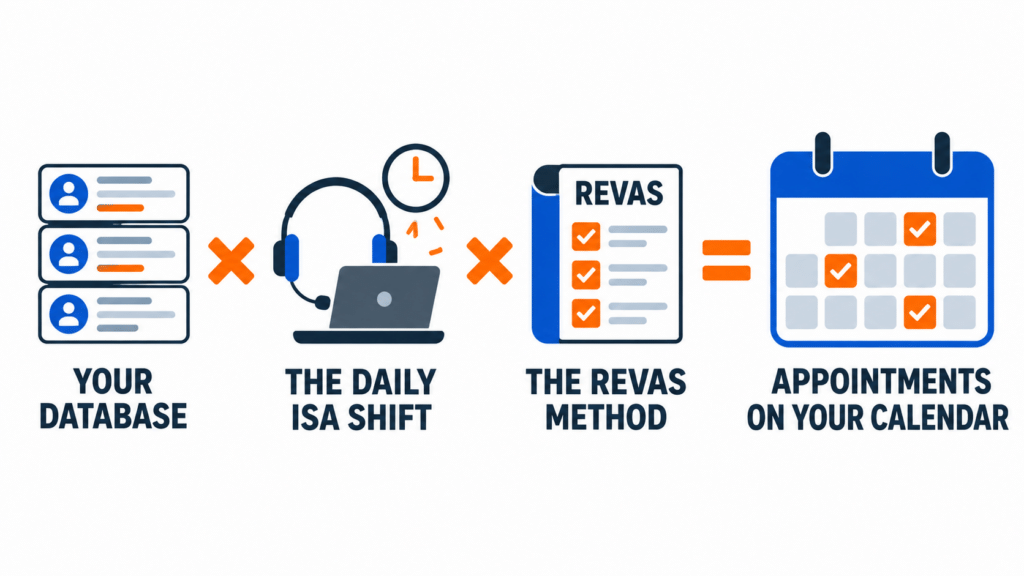
This is the Appointment Multiplier Equation. Multiply the three together, and the product lands on your calendar.
In multiplication, a zero in any one factor makes the whole answer zero, however large the other factors are.
A database nobody works books no appointments.
The same arithmetic also runs in your favor. If this service fits your business, the first factor is already strong: your lead generation has done its job.
✓ The database is built.
✓ You can close what gets booked.
The missing link is the consistent, never-ending, systematic follow-up. This is the unglamorous but necessary work that turns leads into appointments.
A proven way to fill that missing link is with a dedicated ISA working a daily shift focused on one thing: setting qualified appointments from your database.
Your database stays as it is, and so do the people taking the appointments. The lift comes when the ISA’s shift starts, and it lasts as long as the calls and follow-up attempts keep getting made.
| The Old Way | With ISA Ops | |
|---|---|---|
| When do calls happen? | In a time block, when nothing more urgent comes up. | In a fixed block of hours every working day, with nothing else scheduled in it. |
| Who owns the list? | You, or whichever agent the lead was routed to. | One dedicated US-based ISA. |
| Where do the best scripts live? | In your head, or your best agent's. | In your own Script and Playbook, built from your best calls. |
It’s 9:40 on a Tuesday night and the CRM is open again. You’re scrolling through leads you paid for and leads you earned: portal inquiries from March, sign calls from last spring, a referral from a past client that has been sitting there for months. Nobody has called them back. Mid-scroll, your phone buzzes. A new lead just came in through your capture form, and you can’t call that one tonight either.
Meanwhile the workaround runs. The Sunday night blast goes out to the whole database, and Monday morning two past clients unsubscribe.
How many leads in your CRM haven’t had a real conversation since the week they came in?
And how many of those were referrals, sent by a past client who trusted you with a friend?
Every coach you’ve hired has a fix for this, and it’s usually the same one: time-block two hours a day for database follow-up, every salesperson, no exceptions. The fix is real. Teams that sustain it get results. Almost no team sustains it, and the reason has nothing to do with discipline.
Closing work is supposed to win every scheduling conflict. Look at what the callback list is up against in any normal week:
Every one of those beats the callback list, and every one of those should. Which means the follow-up loses every week, no matter how good your people are, because nobody on your team has a shift where the callback list is the most important thing on it.
That is a staffing structure, and it stays broken until the follow-up gets a shift of its own.
This isn’t a you thing. Separate research teams measured different parts of lead follow-up, two years apart. Harvard Business Review timed how fast companies respond to a new web lead. Velocify counted how many contact attempts a lead actually gets.
Between them, the studies covered more than two thousand companies and millions of lead records, far too many for the pattern to come down to anyone’s personal habits. Both found leads getting lost in the same place: the calls that should happen after an inquiry.
And the numbers are old enough to prove the point. Neither study is new, and the industry has known about this longer than most of your leads have been in your CRM.
Read together, the numbers show where the follow-up breaks. The first call comes late or not at all, and half of all leads never get a second one. Yet the leads that do convert are still being reached as late as the sixth attempt.
The problem has been measured for over a decade and it still isn’t fixed, because it was never a knowledge problem. It’s a staffing problem.
Odds are you’ve already paid to fix this at least once.
An in-house ISA who was good at the job right up until the Friday she quit, and her objection handling left in a notebook under her arm.
Or a cheap marketplace caller overseas, unmanaged, reading a script he didn’t understand to people who could hear it.
Or a dialer, and the lead who resented getting a machine and never picked up again.
None of it failed because you picked wrong or didn’t try. Every coach told you the money was in the follow-up. None of them handed you anyone to do it.
They told you to dig. Nobody handed you a digger.
We’re not guessing. We’ve watched this from the inside at more than 400 real estate companies. Since 2013, REVAS has fulfilled more than 700,000 hours of work for real estate companies.
Over 150,000 of those hours were spent on live calls, predominantly for Realtors and residential investors, and the script and rebuttal library we run today was built and revised from what those calls kept teaching us. That library is what your Follow-Up Playbook gets merged with: your own best calls, plus what 150,000+ hours taught us.
Ready for Your Own Fully Managed ISA Operation?
If you’re ready to start generating more qualified appointments from your existing database, ISA Ops is the most direct way to get there.
The best way to find out whether it’s right for your business is a one-on-one Strategy Session with our CEO, Ali Murtaza.
On that call, he’ll review your database and your current situation with you, and run rough ROI math so you can see whether the numbers work.
To start that conversation, book your Strategy Session below.
The Appointment Multiplier is three factors multiplied together:
That is the Appointment Multiplier Equation. Here is what each factor looks like once your ISA’s shift is running, one factor at a time, ending where the appointments land.
The first factor is the one you already have. Before your ISA makes a single call, we learn your CRM: how your leads arrive, how your team logs dispositions and notes, and the cadences you’ve already built. We work inside what’s already there, and nothing you’ve set up gets moved or overwritten.
From there, your database sets the day’s work. Each shift, the list is whatever it needs called:
Every call gets dispositioned in your CRM as it happens, under your team’s own conventions. When one of your agents opens a record, what happened on the call is already there.
The second factor is the person on the phone.
Your ISA is US-based with direct real estate sales experience: licensed agents and acquisition managers, with two to three-plus years of it behind them before they ever take a shift for you.
We never train an ISA from zero, so a seller’s objections aren’t new to them, and neither is a lead who isn’t ready yet.
If you’ve ever tried to hire for this seat, you know how hard that experience is to find. Your ISA brings it to the first day of your shift.
Your ISA is dedicated to your account: one named person, working your leads on your shift, with a direct line to your team. There’s no layer between your agents and the person calling their leads.
Experience only matters if the calls get made.
Your ISA works a set block of hours every working day, from about two hours a day up to a full working day, depending on your tier, and calling your leads is the only thing on it.
Earlier on this page you saw why follow-up slips: closing work wins every scheduling conflict, and it should.
The shift takes the follow-up out of that contest. It’s the same person on the same block every day, so the calls happen in your busiest weeks too.
You won’t have to wonder whether the calls happened. At the end of every shift, your ISA files a report covering the day’s work:
Here’s an anonymized example so you can see visually what to expect:

The third factor is everything we run behind the seat, and it starts with the step that makes an experienced ISA yours. Your ISA already knows how to work a real estate lead. What they don’t know yet is your market and the way you talk to your leads.
The Script Extraction Call is how they learn it. We interview you about the calls that matter and run your common objections at you in live role-play, recording what you say that works. From that recording we build two things:
You own both permanently. If you already have scripts and training materials you trust, send them over and we build from those instead.
Your ISA trains on both before the first dial. From then on, the Script is open on every call, and when a lead pushes back, the ISA clicks straight to your rebuttal and keeps the conversation going. The experience comes with the person, and the Script and the Playbook make the words and the process yours.
As we always say at REVAS:
“A person is not a solution to a problem without a process.”
When a conversation turns into a live opportunity, the handoff takes one of three forms:
Whichever form fits the moment, that is the handoff, and it is the boundary line of the whole service: we own everything up to it, and your team owns the close.
What counts as appointment-ready is your standard: we capture it during onboarding, write it into your Playbook, and your ISA qualifies to it.
And when a booked appointment falls through, it isn’t dead: kick it back to your ISA, who follows up to find out what happened and reschedules it the way your process calls for.
That is the Appointment Multiplier in motion.
Every lead nurtured on your Playbook, because follow-up is finally somebody’s only job.
The daily report shows you the phone work. A regular review call with us covers what happens next: we walk through the handoffs and where each opportunity stands, so one that stalls on the way to the finish line gets caught while there’s still time to act.
The same call is where your Script and your Playbook stay current. When an objection changes or a handoff route stops working, we see it there, and we adjust what your ISA runs to match.
Cold calling to strangers stopped working for everyone at once.
What survived the collapse is narrow and specific: a callback, from a real local number, from a live person, about something the lead actually asked about. That is the only call the ISA makes.
Here is what that looks like from your lead’s side of the phone:
And when nobody picks up, your ISA leaves a personalized voicemail in their own voice:
Both surveys ran in customer-service contexts rather than real estate specifically, and the direction is hard to miss.
When Forgotten Leads Become Booked Appointments
A few weeks after launch, it happens. A lead comes up on the day’s list that you wrote off a long time ago: an inquiry on a listing from fourteen months back, four attempts logged and then nothing. Your ISA calls, from your local number, and opens with the property they originally asked about.
They answer. They’re still thinking about selling, actually, and the timing is better now. The ISA works the conversation with your Script open, clicks to your rebuttal when the hesitation comes, qualifies them, and books the appointment straight onto your agent’s calendar. The disposition and the notes are in your CRM before the next dial.
You never touched it. Your database was deep enough to feed the shift, and your agent showed up to take the appointment. The next morning, the shift ran again.
Two of the things that made that appointment possible sit on your side of the table: the leads to call, and someone ready to take what gets booked. The Strategy Session is a short call with our CEO, Ali, to find out whether you have both. If you don’t, he’ll say so.
If you’ve tried to fix your follow-up before, it was probably with an in-house ISA, a cheap overseas caller, or a dialer. We covered the dialer above: your leads get a live person on a local number. The sections below take on the other two, then what you keep and what we need from you.
ISAs are people, and people move on. We plan for it, and the replacement is on us: we recruit and train your next ISA at our cost.
If you’ve had an in-house ISA quit, you know the objection handling went out the door with them. Here, it lives in your Playbook, and your Playbook stays with you.
You’ll notice a new voice on your account. What you won’t notice is the follow-up stopping.
When a new ISA comes on, none of your setup has to be redone. They train on your Script and your Playbook before their first dial, the same way your first ISA did. They call from the same dedicated local number, and the shift keeps its hours. You won’t have to explain your business to anyone twice.
You never recruit, hire, train, or manage anyone.
A cheap overseas caller usually comes with nobody behind him. You end up managing him yourself, and the script in front of him is one he doesn’t understand.
Your ISA has a managed operation behind every shift. Your Ops Manager is the REVAS manager who trains your ISA on your Script and your Playbook, checks the quality of the work, and covers the shift when your ISA is out.
The Ops Manager isn’t a gatekeeper. Your team talks to your ISA directly, and the Ops Manager works in the background.
And the Script your ISA works from isn’t a stranger’s. It was built from your own best calls and merged with the script library we’ve developed since 2013, so it still sounds like your business. Inside it are the scripts, the rebuttals, and the answers to the questions your leads ask every week, in one clickable asset kept clean enough to use mid-conversation.
Your ISA’s performance gets tracked over time, and if anything starts lagging, it’s flagged early and brought to you and your ISA, with your Ops Manager running point until it’s fixed.
Your feedback steers it too. When you tell us something worked, we do more of it, and when something went wrong, we note it and fix it. Between the End-of-Shift report and the calls logged in your CRM, you can check the work yourself whenever you want.
Here is what belongs to you, from the first shift:
Even a call that doesn’t produce an appointment leaves the record better than it found it, with a status, a note, and a next action you own.
If you ever leave, all of it stays with you, and the next thing you try starts from everything we built together instead of from zero.
One honest thing before the proof, because you may have lived it: there are follow-up services that move leads one step down the funnel and let them die at the next, because nobody on the client’s side picks the opportunity up. We watch for that pattern from week one, and preventing it takes three things from your side:
Notice what’s on that list. It’s closing work, the work your side is best paid to do. The callback list is ours now. What stays with you is only the work that was winning the scheduling conflicts anyway.
Here is how a new ISA Ops engagement starts.
One scheduling note: we take on a handful of new ISA Ops clients a month, usually two to five, because every ISA is dedicated and every launch gets set up by hand. When a month fills, new starts move to the next one.
Ready for a Straight Answer on Whether This Fits?
The Strategy Session is a short one-on-one call with our CEO, Ali. He’ll ask about your database and your numbers, and then he’ll answer the question above: yes, this fits, or no, it doesn’t.
If the answer is no, he’ll tell you why and point you at what to build first.
REVAS has been generating phone appointments for real estate companies since 2013.
Callback shifts, database reactivation, inbound qualification at volume: this is work we’ve been running inside real engagements for more than a decade.
Here are three of those engagements, each with its scope spelled out.
A Southern California real estate team came to REVAS with a CRM holding more than 33,000 leads: online inquiries, inbound marketing calls, older lead lists, and buyers and sellers who had asked to be contacted again in three to six months. They didn’t have a lead problem. The problem was what happened after a lead came in.
The detail that tells the whole story: sellers had said “call me again in three months.” Three months would pass. Nobody called, because the callback belonged to whoever happened to remember it.
A dedicated ISA took ownership of the pipeline on a set recurring shift and started working through the database. The first month rebuilt it: every record worked got a status, a next action, and a follow-up date. Dead leads got marked dead, so the team finally knew what it actually had. Dormant conversations got reactivated. Promised callbacks went back on the calendar. Qualified opportunities were routed to the team’s agents.
After the rebuild, the ISA stopped opening the CRM to figure out who to call. The day’s work was already waiting: the calls due, the follow-ups due, the callbacks arriving on the date the prospect asked for. The CRM went from storing leads to running the follow-up.
The agents came into a conversation when there was something worth coming into: a serious buyer, a motivated seller, a booked appointment. And once the existing database was under management, the team could add lead flow with confidence, because a new lead now entered a defined follow-up process instead of a pile.
The engagement is real; the name is withheld because it predates ISA Ops as a packaged offer, and we only put a client’s name behind exactly what their engagement ran.

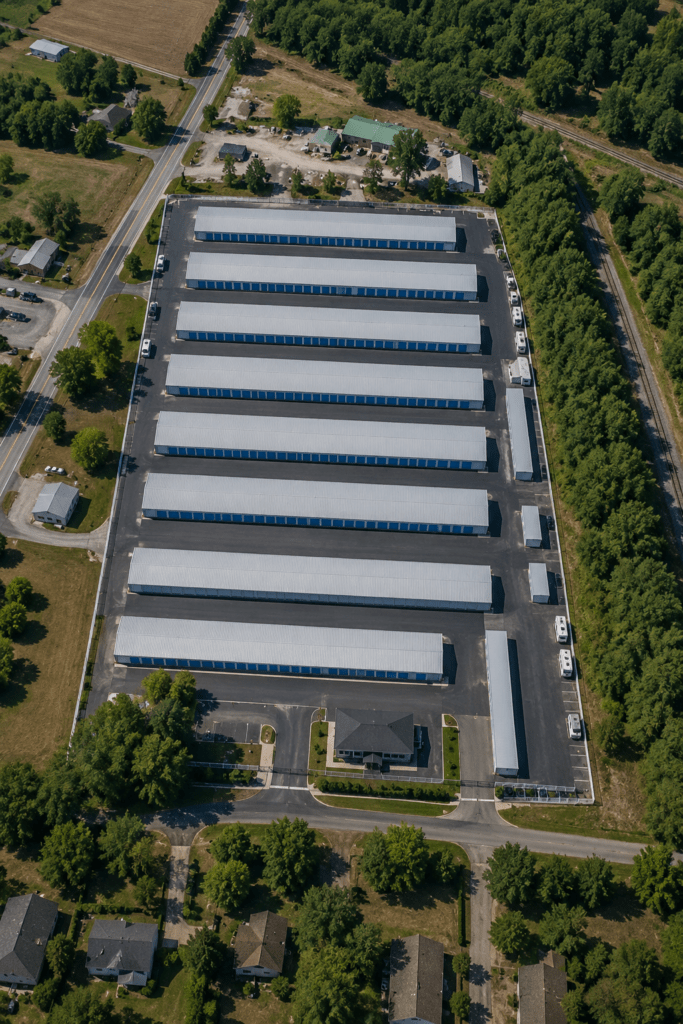
A “we buy houses” operation supplied its own seller lists. REVAS supplied everything after that: the shift, the script, the follow-up, and the handoff.
A dedicated caller worked the client’s records on a set cadence for more than five years, from first dial through pre-qualification to handoff. The caller never guessed what the day held: the client’s cadence was built into the system, and the day’s queue set the work, from new-lead sprints to long-term nurture and reactivation follow-ups. At its full-time pace, the operation held roughly 2,000 conversations a month.
Pre-qualification meant real questions with the answers written down: the reason for selling, the timeline, the asking price, the property’s condition, and who else was part of the decision. When a prospect was ready, the handoff took whichever form the conversation called for: a phone appointment or an in-person walkthrough booked, a real-time transfer, or a text to the client’s team to call the lead back while the conversation was still warm. A prospect who wasn’t ready yet stayed in rotation, with the positive information captured and the next call scheduled.
The seat changed hands multiple times across those years, and the campaign held. Each new caller trained on the same script and the same process, the qualifying questions and handoff routes kept getting refined, and the shift kept its hours. It is one of the longest-tenured calling campaigns REVAS has run, and dozens of closings trace to it across that span.
The client’s side took the handoffs, and deals closed on the other side of them. That is the part most follow-up services never get to prove.
One scope note, stated plainly: the client’s lists were purchased seller lists, so the first call was cold. The client supplied and paid for every record; REVAS never built the list. Everything after first contact is the ISA Ops motion.
For a property management company operating across eight-plus states, REVAS qualified and routed inbound leads at volume: 250+ a month, for more than four years, through the client’s growth and up to the company’s acquisition.
During set hours, calls to the company’s main published phone number rang to REVAS. Website inquiries got a callback. From there, every contact moved down a fully mapped routing flow inside the client’s own systems: tenant maintenance issues to the client’s maintenance call center, leasing inquiries into qualification and scheduling, prospective new clients to the principals. Every step was documented as it happened.
The calling scope was tenant and leasing qualification and scheduling; maintenance ran through its own call center, and new-client appointments were a small minority. What it shows is narrow and real: inbound capture can be worked at volume, and handed off, without the client’s team ever touching the first contact.
Three kinds of buyers should not buy ISA Ops. Here they are.
The shift needs leads to call. If you’re new and haven’t built a database yet, if your database is too small, or if your leads live in your head and your text threads instead of a CRM, there is nothing here for an ISA to multiply. A workable lead is nothing fancy: someone who raised a hand at some point and who you believe warrants a follow-up call. The working floor is roughly 10 open leads for every monthly ISA hour: a 40-hour month needs about 400 workable leads, with 50 or more new leads a month coming in if you’re starting near that floor. Below the floor, the shift runs out of people to call, and you’d be paying for hours your database can’t feed.
An ISA Ops appointment costs $100 to $180 on top of whatever the lead already cost you, and $180 is the honest worst case. Your deal economics have to absorb that number and still produce a return you’re happy with. $500,000+ average transactions are the comfortable zone (preferred, not required). If your margins are thin enough that $180 per appointment changes the math, this doesn’t work for you.
The ISA books the appointments; your side attends them and closes. If nobody on your team is ready and qualified to take a pre-qualified appointment and drive it to a close (calendar access granted, appointments attended, someone owning each opportunity), the appointments die on your calendar. No ISA can fix that from our side of the handoff.
And if you’re not in residential real estate but you run appointment-driven, high-ticket sales off bought or internet leads sitting in a CRM, this works almost the same way for you: book a Strategy Session and ask.
ISA Ops is billed in monthly batches of ISA Hours: you pay once a month, in advance, for a set number of hours, and unused hours roll over. Three tiers, with the rate dropping as the hours grow.
The tracked pattern comes out of the same phone operation that built our script and rebuttal library, running since 2013: roughly one booked appointment for every 4 to 6 ISA hours, and roughly one nurture conversation for every 2 to 3. The two overlap: a 4-hour shift can produce an appointment plus a nurture or two. The ranges are ranges because clients define “appointment-ready” differently, and we would rather hand you the honest band than a precise number we made up.
A nurture is a lead we’ve touched who is still interested and not yet appointment-ready.
Setup is a one-time $500, and the platform fee is $29 a month. The setup fee covers everything between your signature and the first dial; once setup work begins, it isn’t refundable.
Here is the worst case first. At the 40-hour tier, ISA hours run $30. The tracked pattern is roughly one booked appointment per 4 to 6 ISA hours. Six hours at $30 is $180 per appointment. That is the honest worst case, on an hourly-only basis with no bonus layer in the math.
The best case runs the other way: four hours at the 160-hour tier’s $25 rate is $100. The range is $100 to $180, every input is on this page, and you can rerun it yourself.
Hold onto that $180. It’s the number the rest of this math runs on.
What an appointment turns into is your side of the math. In our experience, a typical residential operation converts somewhere between 1 in 10 and 1 in 25 of its appointments, with the strong end near 1 in 10; check that range against your own numbers, because yours are the ones that count.
At the $180 worst case, that puts your cost per closing from leads already in your CRM between roughly $1,800 and $4,500, with no new lead purchased. Set that against what the same closing costs you from bought leads.
Online and portal leads convert at 0.4% to 1.2% (widely cited to NAR via Inman), which means buying roughly 85 to 250 leads for every closing.
On the referral models, the closing then takes a haircut on top: Zillow’s Flex fees have run 15% to 40% of commission, commonly around 35% (Mike DelPrete via Inman Intel, October 2023), and realtor.com’s ReadyConnect has charged 30% to 35% (Inman, January 2023).
A lead already sitting in your CRM adds none of that. Zero incremental acquisition cost.
At 80 hours and up, you’re buying a real share of a full-time ISA, and one full-time ISA can feed pre-qualified appointments to 2 to 4 agents.
At the 40-hour tier, skip the spreadsheet: $1,200 a month is your list finally getting called.
Performance pay is optional, and the hourly rate is the whole price. If your economics support it, we encourage a bonus for your ISA, because incentive-topped ISAs perform better and stay longer. It’s your call, on your terms, and no bonus is ever expected.
A bonus can be tied to anything easy to measure that doesn’t run through a closing: most commonly a flat amount per attended appointment, or a discretionary bonus on whatever calendar you like. It can’t be tied to closings or a share of commission, because ISA Ops doesn’t run through a real estate license; the bonus stays one step upstream of the close.
Every bonus runs through REVAS: you arrange it with your Ops Manager, we invoice it, and your ISA receives it through payroll. Your ISA keeps 80% of every bonus; our 20% covers the processing and payroll cost, and nothing more.
One dedicated ISA at 160 hours a month is the top of the standard ladder. If your database and your team can feed more than that, a second full-time ISA runs at the same $25 rate: two seats is $8,000 a month, and the price is linear because our cost to deliver it is linear.
Two full-time seats: $8,000 per month.
Three or more full-time seats is a different conversation, and we’d rather have it with you than publish a price for it. If you’re operating at that scale, book a Strategy Session with our CEO, Ali, and we’ll tell you honestly whether ISA Ops is even the right structure for you.
Every ISA Ops engagement carries three guarantees, in plain English.
Everything the engagement builds belongs to you, permanently. The Follow-Up Playbook and the custom Script are yours, and so is the working data: every contact, contact note, disposition, and activity log the shift produces, logged in your CRM under your own conventions from the first shift, so the data never leaves your building. A shift that books nothing still leaves every record it touched current, with a status, a note, and a next action you own. If you ever leave REVAS, you keep all of it, and none of it needs us to keep working.
ISA Ops starts with a three-month minimum and runs month to month after that. The hard terms, stated here so nothing surprises you later:
After the minimum, you stay because the shift is producing, and for no other reason.
People change jobs, and ISAs are no exception; we plan for it. If your ISA moves on, you’ll notice: this is a named person on your account, and a new voice will introduce itself.
What you won’t notice is the follow-up stopping.
We recruit, train, and replace at our cost, the new ISA trains on your Script and your Playbook, and the shift keeps its hours. The system survives because the system was never inside one person’s head.
Even the Worst Case Isn't Zero
Run the worst case yourself. You complete the three-month minimum, decide ISA Ops isn’t for you, and leave. You walk away owning your Follow-Up Playbook, your custom Script, and three months of dispositions in your CRM, logged by a shift that ran every working day: statuses current, dead leads marked, live conversations scheduled, plus whatever appointments those shifts produced. That’s the floor, and it isn’t zero. The realistic case is what the Strategy Session is for.
Here’s the honest math: two hours, minus sign-in and warm-up, minus the End-of-Shift reporting, is roughly 90 minutes of focused dialing a day. That’s real: enough to warm, nurture, and set appointments from a modest database, every working day, at a reasonable price. It is not built for speed-to-lead or for a team’s full lead flow. If your database is bigger than 90 minutes a day can serve, start at 80 hours; the math on both is up in the pricing section.
They roll over, indefinitely. In practice rollover rarely fires: a missed shift gets made up on another day, and hours carry to the next month only when a make-up isn’t possible. Either way, a paid hour ends up a worked hour.
We don’t record calls on our side, because a recorded call is a call that gets answered less: some states require announcing the recording, and the phone carriers we use can force that auto-played announcement even where the law doesn’t. Quality control runs on everything short of recording review: your Script and Playbook governing every call, the End-of-Shift report landing after each shift, and your Ops Manager’s oversight of the shift. The engine behind it is the feedback loop with you: tell us something worked and we do more of it; tell us something went wrong and we note it and fix it. We track performance over time, and if anything starts lagging, we flag it and bring it to you and to your ISA, with your Ops Manager running point until it’s resolved. And because every disposition logs in your CRM as it happens, you can see the work itself, any day you like.
Yes, under conditions. Texting runs to opted-in contacts in your own database, through your CRM, with three things in place:
Cold texting strangers is out; it’s dead on deliverability and it gets numbers blacklisted. Phone stays primary, with email running from your own domain where possible.
A lead that arrives mid-shift gets called quickly. A lead that arrives outside the shift window is your call, decided at setup and written into your Playbook: your own team takes it while the ISA is off shift, or it waits and the ISA takes it first thing next shift. ISA Ops is a daily-shift operation, and we’d rather say that plainly than sell you around-the-clock coverage we don’t offer.
It goes back to your ISA. We follow up to find out what happened, and the appointment gets rescheduled following your process. We can’t control attendance from our side of the handoff, and we don’t pretend to; what we control is that a no-show goes back on the day’s list instead of dying in your CRM.
Yours, from the first shift. Every status, note, and disposition lands in your system under your own conventions, which is why everything the engagement builds stays with you if you ever leave (Guarantee #1), and why there’s no export project standing between you and your own data.
A dedicated, US-based inside sales agent who has done real estate sales for a living: licensed agents and acquisition managers, with two to three-plus years of it behind them before they ever take a shift for you. We never train an ISA from zero. One person, on your account, running your Script on a set shift. The shift is a fixed block rather than floating hours, because ISAs are booked across clients and a moving shift collides with someone else’s. Fixed is also what makes it dependable: the same person, the same block, every working day.
One call, usually an hour or two, once. On the Script Extraction Call we get you talking through your best calls: how you open, how you handle the objections you hear every week. We record it and build your Script and your Follow-Up Playbook from it. If even that is too much this month, send us your existing scripts and training materials and we build from those. The rest of the setup happens on our side: your CRM, your lead sources, your team’s conventions, so your ISA works inside your systems instead of handing you new ones.
Three months, then month to month. Canceling inside the minimum carries a $500 early-cancellation fee; after the minimum, cancellation is 24 hours’ notice. The setup fee isn’t refundable once setup work begins. All of it is in the 3-Fold Guarantee above, stated the same way.
One list, everything included, against the price:
From $1,200 a month, plus the one-time $500 setup and the $29 monthly platform fee. The Script Extraction Call happens within 1 to 3 days of starting, the shift is dialing within 10 to 15, and the first appointments arrive in weeks.
Already sure? Skip the sales call and go straight to setup: checkout, then a short onboarding questionnaire, then you pick the time for your Onboarding Call.
Your leads are aging today, and the meter runs either way.
A lead is most reachable in the weeks after they raise their hand. Every month after that, the callback gets harder, and the decay runs in stages you can chart in your own CRM:
The clock runs on both halves of your database, the internet leads you paid for and the sign calls, open-house visitors, and referrals you earned, and it doesn’t pause while you’re busy closing. None of this needs a crisis to be true; it’s just what unworked leads do, a little more each month, while new ones keep landing on top of the pile.
The bigger costs never show up on a statement. A lead who finally decided to sell called somebody, and the appointment went to whoever called first.
That deal never appears on any report as lost; it just never appears.
And the leak runs on both sides of your database. A bought lead that goes uncalled leaks the money you spent to get it. A referral that goes uncalled leaks something worse: the person your past client vouched for got silence, under your name.
And no closing in this business is just one closing: it becomes a past client, the past client sends referrals, and the referrals close and send more.
Nobody budgets for a chain that never started.
What your sphere hears matters as much as whether they get called, and what the ISA gives them is your team: a local number, a live person who has sold real estate for a living, the Script from your own best calls. The follow-up runs under your name, and it holds up under it.
There is a version of this you can build yourself, and the price tag is the part you can see. An in-house ISA runs $65,000 to $80,000 a year fully loaded (BLS benefits data, 2025), and typical tenure runs roughly 8 to 18 months, which makes the replacement a scheduled event rather than bad luck.
That number is real, and it is the smaller cost.
The seat needs a system around it, and every piece of it lands on you:
None of those bills you in dollars. They bill you in the hours and attention that were meant for the work only you can do, which is how the build feeds the first two costs: the follow-up gets fixed, and the opportunity cost grows anyway.
ISA Ops is that system built once, already inside the monthly rate. What stays with you is taking the appointments and closing them.
The Choice I Watch Agents Make

From the Desk of
Ali Murtaza
REVAS CEO
Thanks for reading this far. I’m Ali, the CEO of REVAS, and the Strategy Session links on this page will have you book a call with me directly.
Here’s a choice I want to leave you with.
A year from now, you can be exactly where you are tonight: the same database, worked by whoever has time this week, with the follow-up still bet on time blocks that lose to closing work. Some nights the list is still open at 9:40.
Or you can be the owner of a database that produces appointments without depending on you or your team, because calling it is one person’s whole shift.
The difference is structural: in the second version, the follow-up has a dedicated owner.
And this doesn’t make sense for every business: the economics have to support a US-based ISA on a daily shift. If yours can’t, don’t buy this. I mean that. Book the call anyway if you’re unsure, and I’ll tell you straight; I’d rather tell you no than sell you a shift your database can’t feed.
If you have the leads, and your side can take the appointments, the rest is simple, and it’s the promise at the top of this page: more appointments from your existing database, without a single new lead. Every lead nurtured on your Playbook, because follow-up is finally somebody’s only job.
I hope we talk soon,
—
Ali Murtaza,
CEO, REVAS
P.S. The Strategy Session is a short call with me, and you’ll leave knowing whether ISA Ops fits your database. The one thing that doesn’t wait on the decision is the database itself; leads keep aging whether or not anyone calls them.
Choose an option above to get started. If you're not sure where to begin, Book a Strategy Call here.
Notifications

